

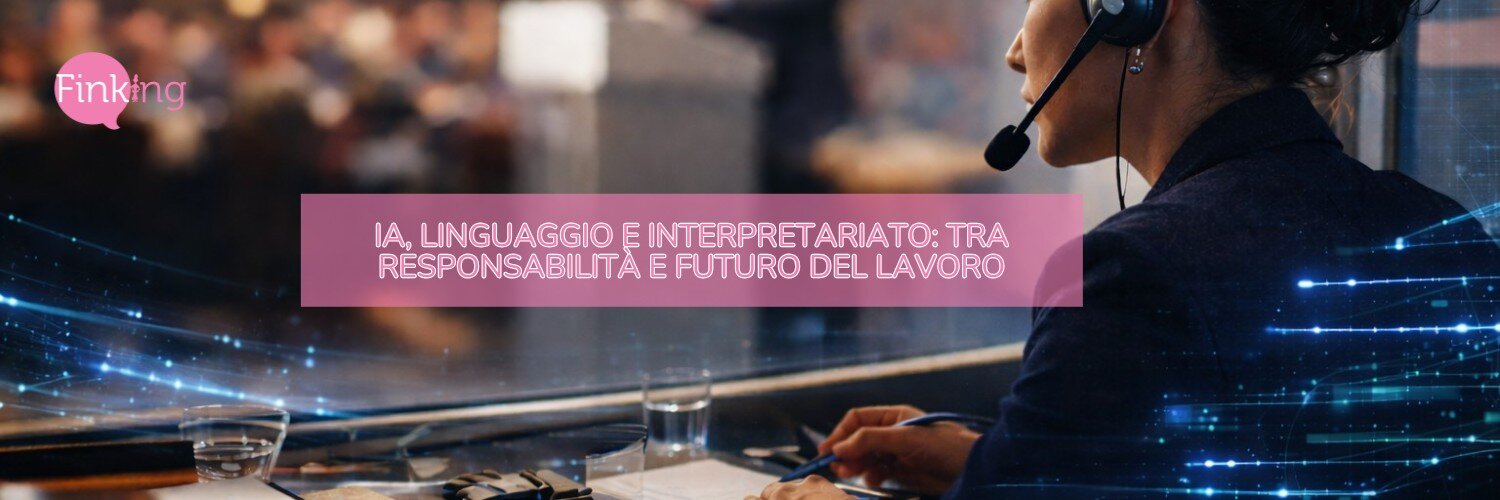
The international symposium “The World Algorithm – Knowledge and Power in the New Global Order”, organised by Ca’ Foscari University of Venice, invites us to consider artificial intelligence not merely as a technological tool, but as a force capable of reshaping knowledge, power and social relations. In a world where algorithms increasingly take part in producing and managing language, a crucial question becomes unavoidable: what does it truly mean to understand? And, above all, who takes responsibility for meaning?
In public, institutional, legal, political or healthcare settings, communication is never neutral. Words have real-world consequences. This is where professional interpreting remains an essential safeguard: it does not simply transfer content, but ensures accuracy, transparency, cultural awareness and accountability towards the people and institutions involved. These are values that no algorithm can be held responsible for.

At the same time, artificial intelligence should not be seen only as a threat. It is reshaping workflows and can offer valuable support: terminology management, the analysis of complex materials, and greater efficiency in certain preparatory phases. When used with expertise and critical awareness, technology can reduce what is repetitive and leave more space for what truly requires human intelligence.
Interpreting, therefore, does not resist innovation: it evolves.
It integrates tools where they add value, strengthens its role where words carry consequences, and preserves what no machine can replace: the ability to understand intentions, read contexts, manage ambiguity, convey meaning and build trust.
In an era in which algorithms are becoming infrastructures of thought, interpreting remains a profoundly human practice. At Finking, we see it as a shared responsibility: not simply to translate, but to ensure that communication is accurate, conscious and reliable, especially where decisions, rights and relationships are at stake.


