

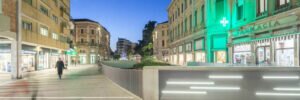
From the Finking shop window at Via Colombo 51, heading toward Corso del Popolo, you enter Piazza Barche; instead of turning left, this time turn right toward the M9 Museum. The street that runs alongside the Museo del Novecento is Via della Brenta Vecchia. But why does this street have this name, why is it called “Brenta Vecchia” (Old Brenta)? Because between the mid-sixteenth century and the end of the seventeenth century, part of the land now occupied by the street and today’s buildings was taken up by a watercourse.
Diverting rivers away from the lagoon, or reducing their flow, both large and small, so that they would not fill it with their debris was an obsession for the Venetians. Even a small stream like the Marzenego, which flowed into the lagoon at Cavergnago, too close to their city, was considered a danger. As for the place name chosen by modern administrators, which would suggest the existence somewhere of a “New Brenta,” there is no other explanation than that they consulted a map from 1750, where the riverbed is shown, so it is labeled, of the “reclaimed channel of the ancient Brentella.”
Be that as it may, in this brentella the water did not flow as those who had planned the work had intended. Because of the very slight gradient, the ditch soon silted up and the water stagnated: sixteenth-century documents insist on the “poor quality of the air.” As a result, in 1667 the community of Mestre was authorized to close, at its own expense, the stretch of canal between the Capuchins and the monastery of Santa Maria delle Grazie.
The twentieth century, in parallel with Mestre’s transformation into an urban organism, ushered in a new phase of profound changes in the layout of the area, changes that are still ongoing. Some photographs taken in the early 1950s give us an image of bleakness: the impression is that of a bombed-out area from which the rubble has only just been cleared.
Then came a moment of rethinking, a desire to give Mestre the form and dignity of a city. And so, in recent years, new sidewalks, a cycle path, public green spaces, and street furniture appeared. Finally came the ambitious M9 project which, for the time being, has altered the landscape in this way: it removed the Carabinieri barracks and some structures in the courtyard of Santa Maria delle Grazie, opening up more sky; it did away with the green flowerbed with trees, shrubs, and benches along the western side of the street, replacing them with a yellow wall of chipboard.


