

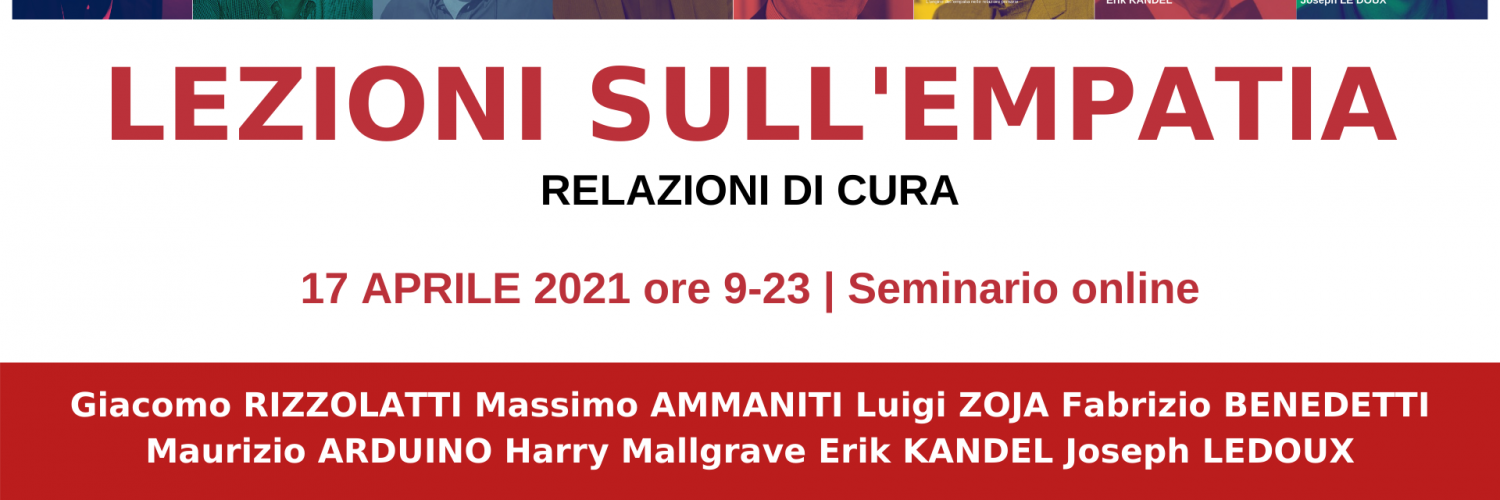
THE PHYSIOLOGY OF EMPATHY.
Mirror neurons are the basis of empathy, that is, our capacity to relate to others, to understand them, and to share in their suffering and their joys. Rizzolatti discovered that in the brain areas responsible for movement, the motor areas, the same neuronal activity occurs both in the person performing an action (for example, grasping a glass) and in the person observing it. This is why, in the observer, these neurons are called “mirror neurons.” At the cerebral level, therefore, if I watch you drink, it is in some way as if I were drinking too; if I watch you drive, it is as if I were driving as well. In this way, I not only learn what you are doing, but I also understand your intentions.
Empathy thus means stepping into another person’s shoes, because our brain attunes itself to the brain of those around us.
ANALYTIC RELATIONSHIPS.
With Luigi Zoja, one of the world’s leading figures in Jungian psychoanalysis, we will enter the analytic room, the spaces of encounter—or of analytic confrontation. From the projection of individual qualities onto external objects or people, from the total participation of animism, through polytheism and monotheism, to the secularisation of modern society in which religion survives as an individual choice; and post-modern forms of rejection of participation expressed in withdrawal syndromes and their limits.
THE WORDS OF CARE.
All of us hope for something. But the patient hopes more than anyone else. And words are the most important means of instilling hope: empathic words of comfort, trust and motivation. Today science tells us that words are powerful arrows that strike precise targets in the brain—and these targets are the same as those of the drugs used in routine clinical practice. Words trigger the same mechanisms as medications, thus transforming from abstract sounds and symbols into real agents that modify the brain and the body of the person who is suffering. This is the key concept now emerging, and recent discoveries confirm it: words activate the same biochemical pathways as drugs such as morphine and aspirin.
Fabrizio Benedetti, one of the world’s leading scholars of the placebo effect, presents in this lecture a revolutionary approach to illness and healing, demonstrating the importance of positive verbal suggestions and their power to modify the brain and the entire organism. He opens up an innovative perspective in which words of hope—an essential ingredient of every therapy—become an integral part of medical practice. “In this book I want to convey a message: words, hope and drugs induce similar effects through similar mechanisms. I do so by speaking of science, but also by telling brief stories of patients that helped us understand all this. Only through this dual approach—science on the one hand and the perspective of those who suffer on the other—can we grasp the true power of hope in suffering and in illness.”
PLACES THAT HEAL.
Mallgrave writes: “(Beauty) is simply an integral part of the way we come into contact with the things around us and animate them, of how we express our vitality and our sense of being alive.” The fact that we perceive (and therefore conceive) the built environment through our entire body may seem obvious, yet by training architects tend to think of buildings as abstract objects or formal compositions existing in free geometric space, rather than as existential places of our tactile knowledge. Mallgrave’s lecture therefore reflects on the care of places of care: on beauty as healing, and on spaces as places (or non-places) of care.
EMPATHY AND NEURODEVELOPMENTAL DISORDERS.
Caring for an autistic child requires strategy, flexibility, patience, intelligence and courage. One must be a little psychologist, a little therapist, a little engineer of pedagogy and behaviour. Each patient represents a new and difficult challenge. Specific training is necessary, but not sufficient. It is essential to interact with the family, the school and the therapists—and to be very persistent, because when assisting an autistic person there are often moments when one feels unable to go on.
The stories told by Maurizio Arduino all have a positive outcome. They are engaging and moving because, following a chronological thread, the author conveys sensations and emotions and depicts the psychology of the characters—who are, in fact, real people.
THE BIRTH OF EMPATHY.
With Massimo Ammaniti.
THE HIDDEN FACE OF FEAR.
The closing event of this edition is the live-streaming screening of the documentary The Hidden Face of Fear.
Since 11 September 2001, New York has become the centre of a new epidemic of fear and anxiety that rapidly spread throughout the Western world. Just as fear spreads through society, anxiety spreads through the society of our minds.
The Hidden Face of Fear presents the studies of two of the world’s leading experts on fear and anxiety, Joseph LeDoux and Nobel laureate Eric Kandel, and the application of their scientific discoveries to patients at the New York Center for the Neuroscience of Fear and Anxiety.
Three emblematic stories of people suffering from Post-Traumatic Stress and Panic Disorder: what impact did 11 September have on their brains? Why were they more vulnerable than others? Were they able to overcome fear? The study of individual cases is the key to the new science of the mind in addressing fear, psychologically and biologically.


